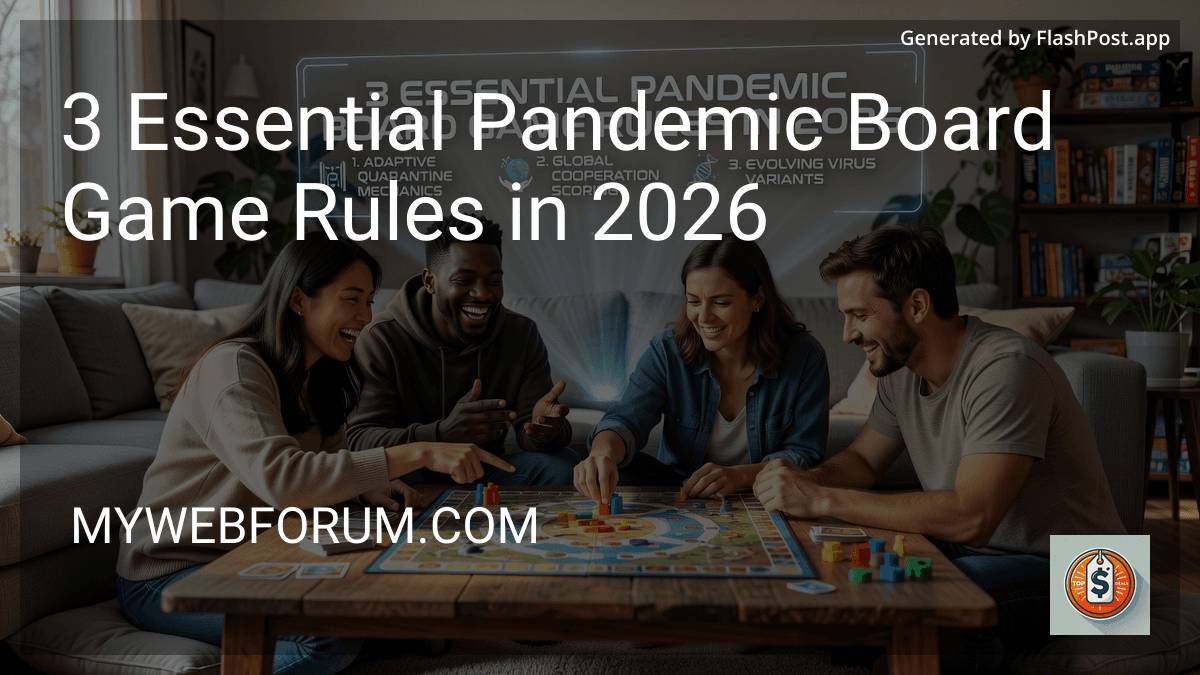
Best Pandemic Board Game Editions in October 2026

Pandemic Cooperative Strategy Board Game, 2-4 Players, 45-60 Min | For team play, cure diseases before time runs out, Rewards planning and communication, Deep strategy with strong replay
- TEAM UP AGAINST OUTBREAKS: WORK TOGETHER TO CURE GLOBAL DISEASES!
- UNIQUE ROLES FOR THRILLING STRATEGY: EACH PLAYER SHAPES THE PATH TO VICTORY.
- PERFECT FOR GAME NIGHTS: FUN FOR 2-4 PLAYERS, AGES 8 AND UP!



Pandemic Legacy Season 1 Board Game (Blue) - Epic Year-Long Battle Against Deadly Diseases! Cooperative Strategy Game for Family Game Night, Ages 13+, 2-4 Players, 1 Hr Playtime, Made by Z-Man Games
-
EXPERIENCE DYNAMIC GAMEPLAY WITH PERMANENT CHANGES AND LASTING CONSEQUENCES.
-
SHAPE YOUR OWN STORY WITH A UNIQUE NARRATIVE TWIST IN EVERY GAME.
-
UNLOCK CHARACTER ABILITIES AND STRATEGIES AS YOU PROGRESS THROUGH THE GAME.
Asmodee Pandemic on the Brink Board Game EXPANSION - Face New Challenges and Save Humanity, Cooperative Strategy Game for Kids and Adults, Ages 8+, 2-5 Players, 45 Minute Playtime
- ELEVATE GAMEPLAY: NEW CHALLENGES ENHANCE THE PANDEMIC EXPERIENCE.
- DYNAMIC STRATEGIES: UNIQUE ROLES AND EVOLVING DISEASES INCREASE EXCITEMENT.
- ULTIMATE TEST: LEGENDARY DIFFICULTY PUSHES EVEN SEASONED PLAYERS FURTHER.

Asmodee Pandemic Reign of Cthulhu Board Game - Investigate and Confront Cosmic Horror, Cooperative Strategy Game, Family Fun for Kids & Adults, Ages 14+, 2-4 Players, 40 Minute Playtime
- TEAM UP TO SEAL GATES AND PREVENT CTHULHU'S AWAKENING!
- CLASSIC PANDEMIC GAMEPLAY WITH A CHILLING LOVECRAFTIAN TWIST!
- BATTLE INSANITY WHILE USING UNIQUE MYTHOS POWERS AGAINST OLD ONES!

Pandemic Hot Zone: North America Board Game - Unite to Save The Continent! Cooperative Strategy Game for Kids and Adults, Ages 8+, 2-4 Players, 30 Minute Playtime, Made by Z-Man Games
- JOIN FORCES AGAINST EPIDEMICS: COLLABORATE TO CONQUER DISEASES TOGETHER!
- QUICK AND ENGAGING GAMEPLAY: PLAY IN JUST 30 MINUTES-PERFECT FOR ALL!
- EXPAND YOUR ADVENTURES: DISCOVER NEW EXPANSIONS FOR ENDLESS FUN!

CATAN Board Game (6th Edition) | Trade, build and settle in a classic family strategy game. Ages 10+, 3-4 Players, 60-90 Min
- GATHER RESOURCES AND BUILD TO DOMINATE THE ISLAND OF CATAN.
- COMPETE STRATEGICALLY AGAINST FRIENDS FOR ULTIMATE VICTORY!
- ENDLESS REPLAYABILITY WITH UNIQUE MODULAR BOARD DESIGN.

Asmodee Ticket to Ride Board Game (2025 Refresh) - A Cross-Country Train Adventure for Friends and Family, Strategy Game for Kids & Adults, Ages 8+, 2-5 Players, 30-60 Minute Playtime
-
EMBARK ON A 20TH-CENTURY TRAIN ADVENTURE ACROSS NORTH AMERICA!
-
EASY TO LEARN FOR NEW PLAYERS; CHALLENGING FOR SEASONED GAMERS!
-
GORGEOUS COMPONENTS CREATE AN IMMERSIVE GAMING EXPERIENCE!

Asmodee Splendor Gem Trading Strategy Board Game, 2-4 Players | For game nights, build a gem trading engine, Just 3 actions keeps turns quick to learn, Rewards timing and long-term planning
- ENGAGING STRATEGY: BUILD YOUR ECONOMIC ENGINE TO EARN PRESTIGE POINTS!
- EASY TO LEARN: QUICK SETUP AND SIMPLE RULES FOR FAST GAMEPLAY.
- PERFECT FOR GROUPS: FUN FOR ADULTS AND FAMILIES, IDEAL FOR GAME NIGHTS!
Carcassonne Tile Placement Strategy Board Game, 2-5 Players, 35 Min | For tile fans, build a medieval landscape, Meeple placement adds strategy each turn, Randomized tiles keep games different
-
BUILD YOUR KINGDOM: DRAW AND PLACE TILES TO CREATE UNIQUE LANDSCAPES.
-
FUN FOR EVERYONE: INTUITIVE GAMEPLAY FOR AGES 7+; PERFECT FOR FAMILIES!
-
ENDLESS REPLAYABILITY: EVERY GAME OFFERS A FRESH CHALLENGE AND FUN.
3 Essential Pandemic Board Game Rules in 2026 still trip up more tables than any disease card draw ever will: outbreak chains, hand-limit timing, and role-based action efficiency. After years of teaching pandemic: the board game to new groups, I’ve noticed the same pattern-most losses don’t come from “bad luck,” but from one rule being misplayed by turn three.
That matters because board game pandemic looks simple on the surface: four actions, draw cards, infect cities, save the world. Yet one missed interaction-especially around epidemics, research stations, or the discard pile-can swing a game from tense and fair to accidentally easy or brutally unwinnable.
If you want a cleaner first teach, a more accurate rematch, or you’re deciding whether pandemic the board game still deserves shelf space in 2026, these are the rules that matter most.
How we select products/games: Our team reviews tabletop titles daily, analyzing player ratings, rules clarity, replay value, expansion support, pricing trends, and long-term buyer feedback to surface games that deliver the best value. For this article, I also relied on repeated hands-on plays of the base game and legacy variants, plus common rules disputes that show up in community discussions and teach sessions.
What are the 3 Essential Pandemic Board Game Rules in 2026 that players most often get wrong?
The 3 Essential Pandemic Board Game Rules in 2026 are these:
- Outbreaks never chain back into a city that already outbreaked during the same infection step.
- You check the 7-card hand limit immediately after drawing player cards, not later when it’s convenient.
- Treating disease, curing disease, and eradicating disease are three different game states with different effects.
If you remember only those three points, your games of pandemic game board will instantly become more accurate.
Here’s why those three matter more than edge cases. They influence difficulty, tempo, and win rate in almost every session, while rarer rules-like the exact wording on a specific event card-may only come up once every few plays.
Why does the outbreak rule change the difficulty so much in pandemic: the board game?
The single most misunderstood system in pandemic board game rules is the outbreak cascade.
When a city with 3 cubes would receive a fourth cube of the same color, it outbreaks instead. You add 1 cube to each connected city, and the outbreak marker advances by 1 step. That part is widely known.
The part players miss: a city can only outbreak once during a single chain reaction. If City A outbreaks into City B, and City B then outbreaks back toward City A, City A does not outbreak again in that same sequence.
That’s not a minor technicality. If you ignore it, one epidemic can become far deadlier than intended, often adding 2 to 5 extra cubes and an unfair extra loss condition through outbreaks.
The clean way to teach outbreak chains
Use this table at the start of every game:
| Situation | Correct rule | Why it matters |
|---|---|---|
| A city at 3 cubes gets another cube | It outbreaks instead of getting a 4th cube | Cube supply stays capped at 3 per color per city |
| Outbreak affects linked cities | Add 1 matching-color cube to each connected city | This creates the cascade tension Pandemic is known for |
| A connected city also has 3 cubes | That city outbreaks too | Chain reactions are legal and central to the game |
| A city already outbreaked in this chain gets hit again | It gets no second outbreak in the same chain | Prevents runaway loops and accidental difficulty spikes |
In practical terms, how to play the board game pandemic gets much easier once one player tracks outbreaked cities verbally: “Atlanta outbreaked already; don’t trigger it again this step.”
Pro tip: Keep a small token near any city that outbreaked during a chain. It’s not required by the rules, but it reduces misplays dramatically in 4-player games where multiple people are resolving cubes at once.
How to play pandemic board game correctly when you draw cards and hit the hand limit
The second of the 3 Essential Pandemic Board Game Rules in 2026 is all about timing.
In how to play board game pandemic, your turn follows a strict structure:
- Take up to 4 actions
- Draw 2 player cards
- Infect cities
If drawing those 2 player cards pushes you above 7 cards, you must discard down immediately before the infection step continues. You don’t get to wait until after infecting cities, and you can’t “temporarily” stay over the limit because your next action would have fixed it.
That timing matters because city cards are resources. In how to play pandemic board game, a delayed discard can accidentally give your team extra information and flexibility-especially when deciding whether to share knowledge, discover a cure, or spend an event card.
Why the hand-limit rule matters most in 4-player games
At 4 players, the card economy gets tighter fast. You’re seeing the same deck split across more hands, so every discard decision has a larger opportunity cost.
I’ve seen new groups keep an eighth card “just for one round” and unknowingly make board game pandemic easier than designed. That mistake especially distorts games involving the Scientist or Researcher, because both roles thrive on precise hand management.
Best discard priorities for new players
If you’re learning pandemic the board game, discard in this order unless the board state says otherwise:
- Duplicate-color cards far from any research station
- Cities unlikely to be used for Share Knowledge
- Cards from a color your team is not close to curing
- Cards in regions currently stable at 0 to 1 cubes
Keep these instead:
- Fifth cure-enabling card in a near-complete set
- Cards matching outbreak hotspots
- Event cards that prevent infection spikes
- Mobility-critical cities linked to key routes
For groups comparing co-op difficulty curves, Cfmnl has a useful angle on how tighter player counts change communication and turn efficiency in cooperative designs.
What is the difference between treating, curing, and eradicating in pandemic board game rules?
This is the third of the 3 Essential Pandemic Board Game Rules in 2026, and it’s the one I correct most often mid-game.
In pandemic: the board game, these are not interchangeable:
- Treating a disease removes cubes from the board
- Curing a disease happens at a research station by turning in the required set of same-color city cards
- Eradicating a disease happens only when a disease is already cured and no cubes of that color remain anywhere on the board
That distinction changes how you evaluate every turn. New players often celebrate a “cure” as if that color is gone for good, but cured diseases can still reappear through infection cards until they’re eradicated.
The fastest way to explain the difference
Use this one-line summary:
- Treat = remove cubes now
- Cure = future treatment becomes more efficient
- Eradicate = that color stops entering play
That final point is huge. Once eradicated, if an infection card of that color appears, no cube is placed. In games with repeated epidemic pressure, eradication often saves more actions than a flashy late-game cross-map move.
Definitive recommendation: prioritize cure over cleanup
The best strategic default in pandemic board game online adaptations and tabletop play is this: cure first, stabilize second, eradicate opportunistically.
Why? Because curing changes the rules of the board in your favor. Pure cleanup burns actions; cures improve every future action of that color.
How we picked these rules and why they matter more than obscure edge cases
A lot of “top rules” lists focus on trivia. I didn’t.
I picked these 3 Essential Pandemic Board Game Rules in 2026 based on three factors I’ve seen repeatedly at real tables:
- Frequency of misplay: these come up in nearly every session
- Impact on fairness: getting them wrong changes win odds immediately
- Teach value: if explained clearly before turn one, they prevent most rules confusion
That same methodology is why buyers still comparing cooperative games often jump from pandemic game board to adjacent genres like cooperative detective board games or broader lists such as best cooperative adventure board games explained.
What should you look for before buying board game pandemic in 2026?
If you’re not sure whether pandemic: the board game fits your group, use these concrete criteria.
1. Rules complexity: best for players comfortable with 15-20 minute teaches
The base game usually teaches in 15 to 20 minutes, but first games often run 45 to 60 minutes. If your group loses focus during structured turn phases, expect rule reminders around epidemics and hand management.
2. Player count: the sweet spot is usually 3 to 4
It plays across a range, but 3 to 4 players remains the most reliable experience. At lower counts, one player may need to mentally manage more roles; at higher discussion-heavy tables, “quarterbacking” can slow turns.
3. Cooperative tolerance: ideal for groups that like open planning
This is a fully cooperative puzzle with visible information. If your group enjoys discussing optimal lines, board game pandemic legacy and the base game can shine; if your group prefers hidden information or chaos, it may feel too analytical.
4. Replay path: consider whether you want the base game or a campaign arc
The standard game offers modular difficulty and strong replay value. If you want narrative consequences and permanent changes, pandemic legacy board game or pandemic board game legacy is the bigger commitment.
5. Expansion interest: buy only if the base loop already clicks
A pandemic board game expansion can deepen the system, but it won’t fix a group that doesn’t enjoy the core puzzle. Play the base experience first, then expand if your table wants more roles, mutations, or scenario variety.
If you’re shopping for younger players at the same time, Topdealsnet is a sensible starting point for age-appropriate alternatives.
Which version of pandemic the board game gives the best value by budget?
You asked for a budget-minded breakdown, so here’s the practical answer without getting lost in collector talk.
Best option under the entry-level budget: the base game
For most people, the best value is still the base version of pandemic the board game. It gives you the purest rules set, the lowest learning friction, and the easiest resale or regifting path if your group bounces off co-ops.
Mid-range sweet spot: base game plus one expansion only after 5+ plays
The strongest value-for-money path is usually base game first, expansion later. After about 5 plays, you’ll know whether your table wants more complexity or is perfectly happy with the original tension curve.
Premium pick: legacy if your group can commit to a campaign
If the same group can meet consistently, pandemic legacy season 1 board game offers the most memorable long-term arc. The catch is commitment: if your group changes week to week, a campaign box is worse value than a replayable standalone game.
My definitive ranking for buyers in 2026:
- Base game for first-time buyers
- Base + one expansion for established co-op groups
- pandemic legacy season 1 board game for a fixed campaign group
That same “buy for your actual table, not your ideal table” logic applies across hobby games, whether you’re browsing niche recommendations on techmoney177.blogspot.com or comparing broader shopping trends through sources like www.google.com.au and www.google.ca.
What do reviews and long-term players say are the biggest red flags?
Across buyer feedback and repeat plays, the red flags are surprisingly consistent.
Red flag #1: your group hates “alpha player” games
Because all information is mostly open, one confident player can dominate turns. If your table already struggles with backseat gaming, board game pandemic may frustrate quieter players unless you set discussion limits.
Red flag #2: you want a light party game
This is not a fill-the-room laugh riot. It’s a structured, efficiency-driven co-op where one inefficient turn can snowball into 2 or 3 outbreaks within a round cycle.
Red flag #3: you’re buying Legacy without a stable group
Pandemic legacy board game gets praised for emotional payoff, but only if the same people show up. A campaign title with rotating players often loses momentum by month two or three.
Red flag #4: you expect luck to outweigh planning
There is randomness, especially from epidemic timing, but skill matters more than many first-time players assume. Groups that improve their card trading, role coordination, and outbreak prevention usually see a clear jump in win rate after 3 to 4 sessions.
💡 Did you know? In the base game, losing by running out of player cards is often a sign your team over-treated cubes and under-prioritized cures. If your losses consistently happen late rather than early, the problem is usually tempo, not bad draws.
Is pandemic a good board game in 2026, or has it been replaced by newer co-ops?
Yes-Pandemic is still a good board game in 2026, and for many groups it’s still the best gateway cooperative strategy game.
Newer titles may offer flashier art, campaign hooks, or asymmetry, but pandemic: the board game remains one of the cleanest designs for teaching action efficiency, shared planning, and risk management. Its biggest strength is clarity: every turn asks you to solve a visible problem with limited actions.
If you’re deciding between the original and a campaign version, the split is simple:
- Choose base Pandemic for flexible replay and easier onboarding
- Choose board game pandemic legacy if your group wants a continuing story
- Choose an expansion only after the base game gets regular play
Frequently Asked Questions
how to play board game pandemic
In how to play board game pandemic, each player takes up to 4 actions, draws 2 player cards, then resolves infections. You win by curing all diseases before too many outbreaks happen, cubes run out, or the player deck empties.
how to play pandemic board game
To learn how to play pandemic board game, focus on the turn order and the difference between treating, curing, and eradicating. Most first-game mistakes happen during outbreak chains and hand-limit discards, not during movement.
how to play the board game pandemic
If you want to know how to play the board game pandemic, start by assigning roles, placing initial infections, and teaching the epidemic card sequence before turn one. A correct teach usually takes 15 to 20 minutes, and that upfront clarity prevents most mid-game rules confusion.
how to win pandemic board game
The best way to win Pandemic board game is to prioritize cures over constant board cleanup. Teams that trade cards efficiently, protect key outbreak clusters, and avoid wasting actions on low-risk cities usually perform better than teams that simply chase the newest fire.
is pandemic a good board game
Yes, Pandemic is a good board game if you want a cooperative strategy experience with clear rules and meaningful teamwork. It’s especially worth buying if your group likes puzzle-solving, can handle a 45-60 minute session, and wants a co-op that still holds up after multiple plays.